![[Cancelled] Homelessness Committee Meeting](/assets/photos/5/news_default_img5f7e6212f2d79.png)
[Cancelled] Homelessness Committee Meeting
Posted on 05/22/2026We apologize but the May 26, 2026 Homelessness Committee meeting has been cancelled

Venice Neighborhood Council Board Meeting — Tuesday, May 19
Posted on 05/18/2026The Venice Neighborhood Council invites community members to attend tomorrow’s regular Board Meeting.
Tuesday, May 19, 2026
6:30 PM
Westminster Elementary School
1010 Abbot Kinney Blvd, Venice, CA 90291
(Enter from the parking lot on Westminster Ave)
The Board will hear presentations on the proposed Santa Monica Airport Conversion Project, updates related to LA28 Olympic planning, and a presentation from the Bureau of Street Services regarding streetlight infrastructure and improvements in Venice.
The meeting will also include:
- Consideration of the proposed Venice Bikeway Network and long-term bicycle safety planning
- A motion supporting increased permanent funding for Los Angeles Recreation & Parks
- Discussion regarding Santa Monica Airport flight impacts on East Venice
- A motion for funding for Neighborhood Council elections
- Committee appointments and Board ratifications
- Funding requests for community organizations including the Venice Heritage Museum and Venice Canals Association
- Budget and outreach expenditures
- Reports from Council District 11, Congressman Ted Lieu’s office, and LAPD
It’s YOUR Venice — get involved!

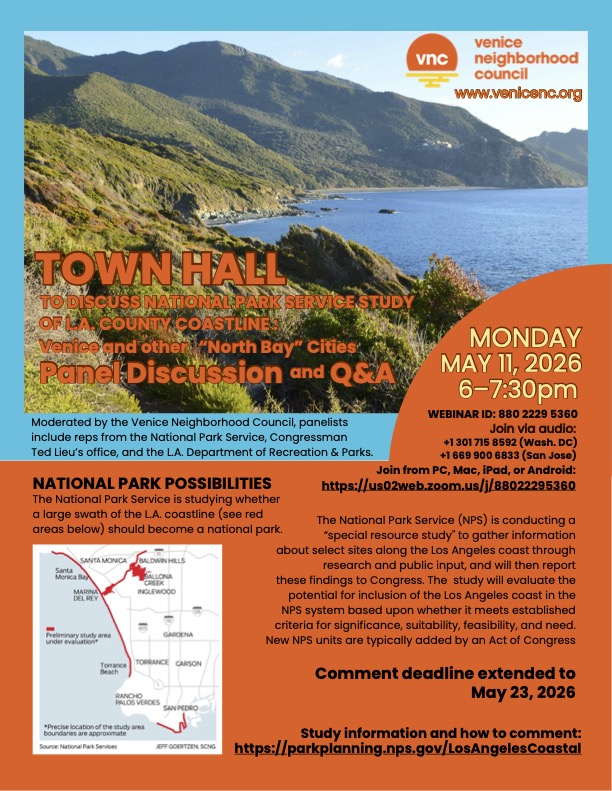
National Park Service Town Hall
Posted on 05/07/2026Join us on Monday, May 11th 2026 from 6-7:30 pm for a Virtual Town Hall to discuss the National Park Service Study of the L.A. County Coastline. The event will feature a panel discussion and Q&A with panelists that include representatives from the National Park Service, Congressmen Ted Lieu's office, and the L.A. Department of Recreation & Parks.
Join via Zoom. For more information, see here.

April Board Meeting
Posted on 04/09/2026Join us Tuesday, April 21st at 6:30 pm for our next Venice Neighborhood Council Board of Officers meeting.
The meeting will be held at Westminster Elementary School, at 1010 Abbot Kinney Blvd Venice, CA 90291. Enter from parking lot on Westminster Ave.
Keep an eye on our calendar for the full agenda. The agenda will be determined by the Adminsitrative Committee on Thursday, April 16th.

Board of Officers Special Meeting
Posted on 04/06/2026Join us on Tuesday, April 7th at 6:30 pm for a Special Meeting of the Venice Neighborhood Council's Board of Officers to discuss proposed changes to the Venice Neighborhood Council's Bylaws.
The meeting will take place online on Zoom. For the meeting link, supporting documents, and the full agenda, visit www.venicenc.org/calendar.

Windward Ave Pedestrian Enhancement Survey
Posted on 04/03/2026The Venice Neighborhood Council’s Parking, Transportation & Infrastructure Committee is exploring potential concepts for increasing the pedestrian areas on Windward Avenue, and is looking for your input! This survey seeks stakeholder opinions on the concepts.
Windward Avenue and its hanging “VENICE” sign are famous. Yet it remains visually dominated by its wide roadway and vehicular traffic. For over 30 years there have been proposals to make the two blocks of Windward Avenue between Speedway and Windward Circle more pedestrian-friendly. The up-coming Olympics provide an incentive for finally doing something. This questionnaire will ask you to comment on two concepts for enhancing the pedestrianization of these two blocks.
There is no adopted plan at this time. The graphics in the questionnaire are concepts only, subject to change and refinement.
For more information, contact the committee at [email protected].
View Previous Posts
Upcoming Meetings & Events
- Jun09 Rescheduling in September - TOWN HALL: RV'S PARKED ON THE STREETS OF VENICE
- Jun10 Budget & Finance Meeting
- Jun11 Administrative Committee Meeting
- Jun13 **VENICE PRIDE BLOCK PARTY at WINDWARD CIRCLE** 4:00pm into the night Click for more Details
- Jun16 Venice Neighborhood Council Board of Officers Meeting
- Jun19 Arbor Committee Meeting
- Jun21 **PAUL RODRIGUEZ GO SKATE DAY Venice Beach Take Over** 12 Noon Click here for Details
- Jun22 Parking, Transportation & Infrastructure Meeting

NEIGHBORHOOD COUNCIL CALENDAR